Synthesis
1. A sodium ethanolate solution was prepared by slowly adding sodium metal flakes (2.30 g, 100 mmol) to anhydrous ethanol (100 mL) at room temperature.
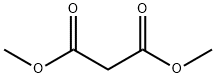
2. After the above sodium ethanol solution was cooled to 0°C, dimethyl malonate (16.0 g, 100 mmol) was added dropwise under stirring within 10 minutes.
3. After the dropwise addition, the reaction was kept at 0 °C for 15 min, after which the reaction mixture was slowly warmed up to room temperature and stirring was continued for 50 min.
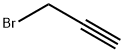
4. The resulting enolide solution was cooled to 0 °C again and 3-bromopropyne (11.9 g, 100 mmol) was slowly added over 20 min.
5. After completion of the addition, the reaction was kept at 0 °C for 30 min, after which the reaction mixture was slowly warmed to room temperature with stirring overnight.
6. After completion of the reaction, the solvent was removed by evaporation under reduced pressure and the residue was washed with distilled water.
7. The aqueous layer was extracted twice with ether (Et2O) and the organic layers were combined.
8. The organic layer was dried with anhydrous sodium sulfate (Na2SO4), filtered and evaporated under reduced pressure to remove the solvent. 9.
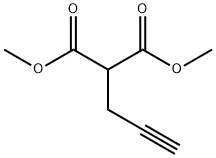
9. The residue was purified by distillation and silica gel column chromatography (eluent: petroleum ether-ethyl acetate, 10:1) to afford dimethyl acetylmalonate (11.9 g, 60.0 mmol) in 60% yield.
Note: This product can also be prepared by reacting triethyl dodecyl formate oxide with 3-bromopropyne.
References
[1] Angewandte Chemie - International Edition, 2014, vol. 53, # 30, p. 7913 - 7917
[2] Angew. Chem., 2014, vol. 126, # 30, p. 8047 - 8051,5
[3] Advanced Synthesis and Catalysis, 2016, vol. 358, # 12, p. 2007 - 2011
[4] Chemical Communications, 2014, vol. 50, # 5, p. 593 - 595
[5] Organic Letters, 2013, vol. 15, # 3, p. 582 - 585